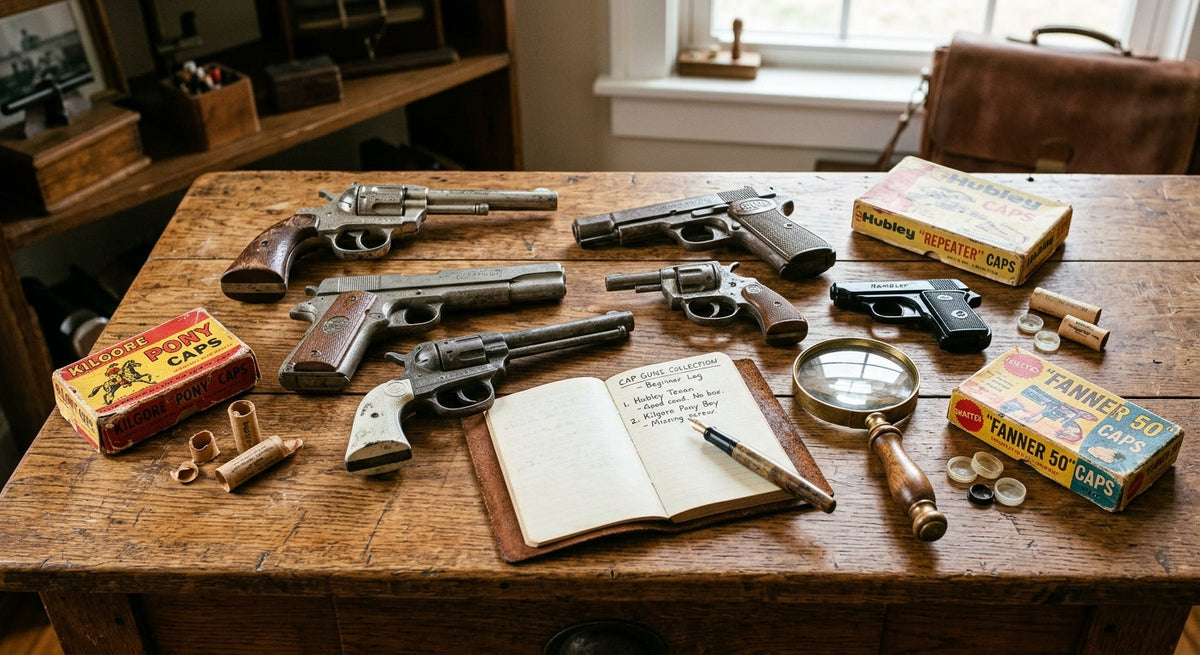
Maybe you've got one old cap gun in a drawer. Maybe you saw a Colt-style revolver in a shop and couldn't stop thinking about it. Either way, you're wondering if this is a hobby you could actually get into.
It is, and it doesn't need to cost much or take up a lot of room. People collect childhood cowboy toys for all sorts of reasons. Some want a few shiny pieces on a shelf. Others end up with a full cabinet and a spreadsheet.
Here's how we'd start, step by step.
Work Out Why You Want to Collect
Before you buy anything, ask yourself what you're after. The answer shapes everything else.
Are you chasing nostalgia, the toys you remember from when you were small? Are you drawn to the metalwork, the weight and detail of diecast cap guns? Do you love the history, from westerns to pirate films? Or do you just like how a good-looking piece looks on a shelf?
None of those is wrong. But a nostalgia collector and a craft collector will buy very different things.
Pick One Theme
A theme keeps you focused and keeps you from buying a bit of everything and loving none of it. A collectors' column in a US newspaper notes that criteria vary from collector to collector. Some stick to one maker, some to one material, and some to one time frame.
For a beginner, a simple theme is best. Western toy guns and cowboy cap guns are the obvious choice, and our western revolvers range is a good place to look. Pirate pistols, police revolvers and military styles all make good themes too. You can always widen out once you know what you like.
Buy One Good Piece
Resist the urge to buy ten cheap ones. Buy one good piece and learn from it.
When you've got it in your hands, check a few things. How heavy does it feel? Is the finish clean? Does the hammer move smoothly and spring back? Are there maker marks? If it came with a box, keep it. Collectors say a cap gun is worth more when the box and paperwork are with it.
For a first piece, a new diecast one from a maker still in production is a safe choice. You know it's complete, you know what condition it's in, and you can ask the shop about it. Of the roughly 80 products at Cap Guns Australia, 46 are Gonher, and most of those are diecast metal toy revolvers and rifles.
Learn to Read the Marks
Maker marks tell you who made the gun and sometimes when. Look on the barrel, the frame and under the grips. Raised lettering is common.
Take photos and write down what you find. Over time you'll start to recognise the makers and the models, and that's when buying gets easier and more fun.
Check the Law First
This is the step beginners skip, and it matters. Before you buy, find out what your state asks for.
Five of the eight states and territories we ship to want police approval for realistic imitation firearms. That's Victoria, New South Wales, Tasmania, the Northern Territory and the ACT. In Queensland, Western Australia and South Australia we don't ask for a permit, though Queensland expects a reasonable excuse, such as collecting, and wants replicas stored securely.
Collecting is a reason that several states recognise. In Tasmania, Tasmania Police say it's the only genuine reason for owning an imitation firearm. NSW has a separate collector permit that covers keeping a collection and displaying it for educational, historic or commemorative purposes.
Machine gun and assault rifle styles need extra care. Tasmania Police classify imitation machine guns as prohibited firearms that need an exemption, so ring first if that's your theme. Our permits and licences page links to each state's police, and we check permits before anything ships.
Set a Budget You'll Stick To
Decide what you'll spend each month or each year. It keeps the hobby fun and stops it turning into stress.
Remember the extras. A display case, a humidity gauge, some soft cloths and permit fees if your state needs them. In NSW, our permits page lists a $75 fee with a maximum term of five years, though fees change.
Quality beats quantity. One clean, complete piece is usually a better buy than three worn ones.
Give It a Home
Even one piece needs a proper spot. Keep it inside, in a dry room, away from direct sun and big swings in temperature. A glass-fronted cabinet is ideal, and a lockable one keeps kids out. Never store or display a loaded cap gun, and keep caps in a separate cool, dry place.
Keep realistic pieces out of view from the street. Police treat a sighting of a replica like a real firearm until they know better, and a cap gun in a front window can cause alarm.
Write It Down
Start a simple record from day one. For each piece, note the maker, the model, where and when you bought it, what you paid and its condition. Take a few photos. Keep receipts and boxes.
It takes five minutes per piece, and it will save you hours later if you want to sell, insure or just remember what you've got.
Find Your People
Collecting is better with other people. Join a collector club or an online group, and go to a collectables fair if there's one near you. People who've been at it for years know what's common, what's rare and what to avoid. They're often happy to share, and a few conversations can save you money.
Take It Slowly
There's no rush. Good pieces come up all the time, and the collector who waits and learns usually ends up with a better collection than the one who buys everything in the first month.
If you've got a free weekend, here's a good start. Pick your theme, check your state's rules and choose one piece from the shop that fits. Put it somewhere safe and look at it every day for a month. You'll know soon enough whether you want a second one.
General information only, not legal advice. Check your state's rules before you buy. Sources: collectors' column in Weekly View; our permits page and FAQ.